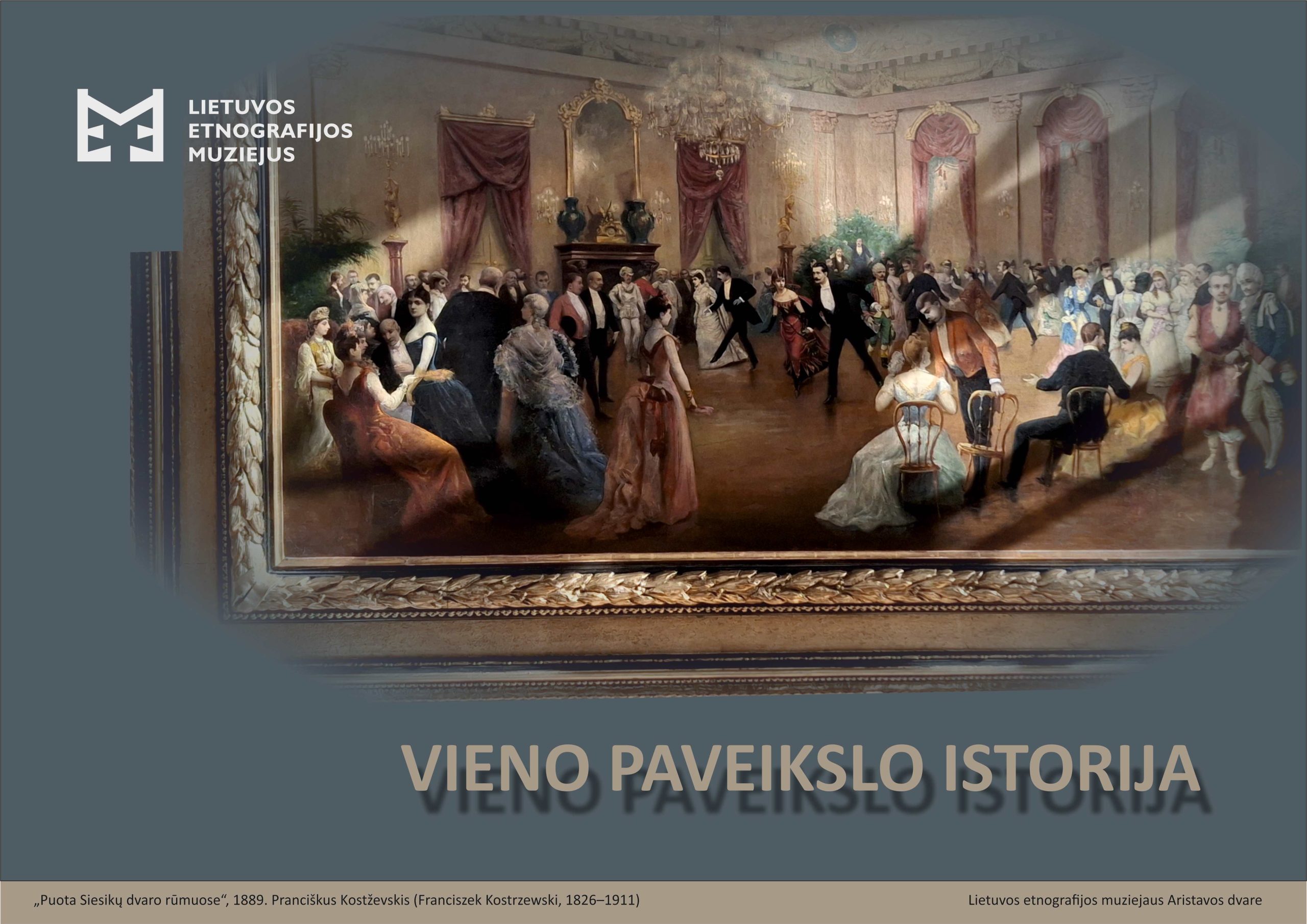
Such a title would vividly reflect the many connections, not only known and clear, but also not fully revealed, only conjectural, connecting the painting “A Feast in the Palace of Siesikai Manor” (1889) and its author, the famous Polish artist Franciszek Kostrzewski (1826–1911), with Lithuania.
And those connections are very diverse, starting with P. Kostrzewski’s teachers at the Warsaw School of Art (now the Warsaw Academy of Arts), who were very closely connected with Lithuania – Professor Marcin Zaleski (1796–1877), who painted scenes of Kaunas and Vilnius, with Chrystian Breslauer (1802–1882), who often sent students to Lithuania for summer internships, and whose brushwork includes romantic scenes of Trakai Castle, or with fellow students Wojciech Gerson (1831–1901) and Józef Simmler (1823–1868), who often turned to Lithuanian motifs and the history of the Grand Duchy of Lithuania in their work.
The ties with Lithuania are related to P. Kostżewski’s travels to our country, starting during his student years and continuing later – together with painters from the Warsaw Bohemian circle, painting natural scenes in nature, traveling to Trakai or during the artist’s individual visits to Lithuania, Samogitia and the Panemunė estates owned by famous Lithuanian noble families, described in his “Diary” (“Pamiętnik”, 1891).
Kostżewski is also brought closer to Lithuania by patriotic themes – the wounded young rebel and his old father depicted praying at a roadside chapel pillar seem to symbolize the joint struggles of both nations for the independence of their countries in the uprisings of the 19th century.
And where are the links with Lithuania, illustrating Adam Mickiewicz’s poem “Mr. Tadas” and with Vilnius, where he participated in exhibitions at least four times at the end of the 19th century. In 1891 and 1893. The Warsaw “Salon Artystyczny” in Vilnius organized exhibitions of Polish painters, in which P. Kostżewski participated. His works were also exhibited in 1897 and 1899 in Vilnius at large, joint exhibitions of Lithuanian and Polish artists, organized by Warsaw residents and sponsored by the Lithuanian banker and philanthropist Juozapas Montvila.
It is much more difficult to reveal the connections of the painting itself with Lithuania – they can only be guessed at. The painting entered the Open Air Museum of Lithuania in 1986 together with other exhibits from Samogitia – the Mantvidiškės manor in Šarnelė manor (Plungė district), and the painting was named so at that time by the well-known museum worker, long-time director of the Kretinga Museum, Juozas Mickevičius (1900–1984). How the painting appeared in Samogitia and what is the origin of its name remains a mystery. Perhaps it was purchased at the popular art salon of Aleksander Krywult (1845–1903) in Warsaw in the summer of 1889. at a large personal exhibition of P. Kostzewski, and from there brought to Lithuania? Perhaps the painting was purchased by the Daugėla nobles – the then owners of Siesikai Castle – for their famous art collection? The archives of Siesikai Castle have not survived. The painting’s connections with Lithuania remain a mystery. At least for now.
Exhibition location: Manor in Open Air Museum of Lithuania.
The exhibition authors: Ina Dringelytė and Neringa Norvaišaitė. The poster author is N. Norvaišaitė.